
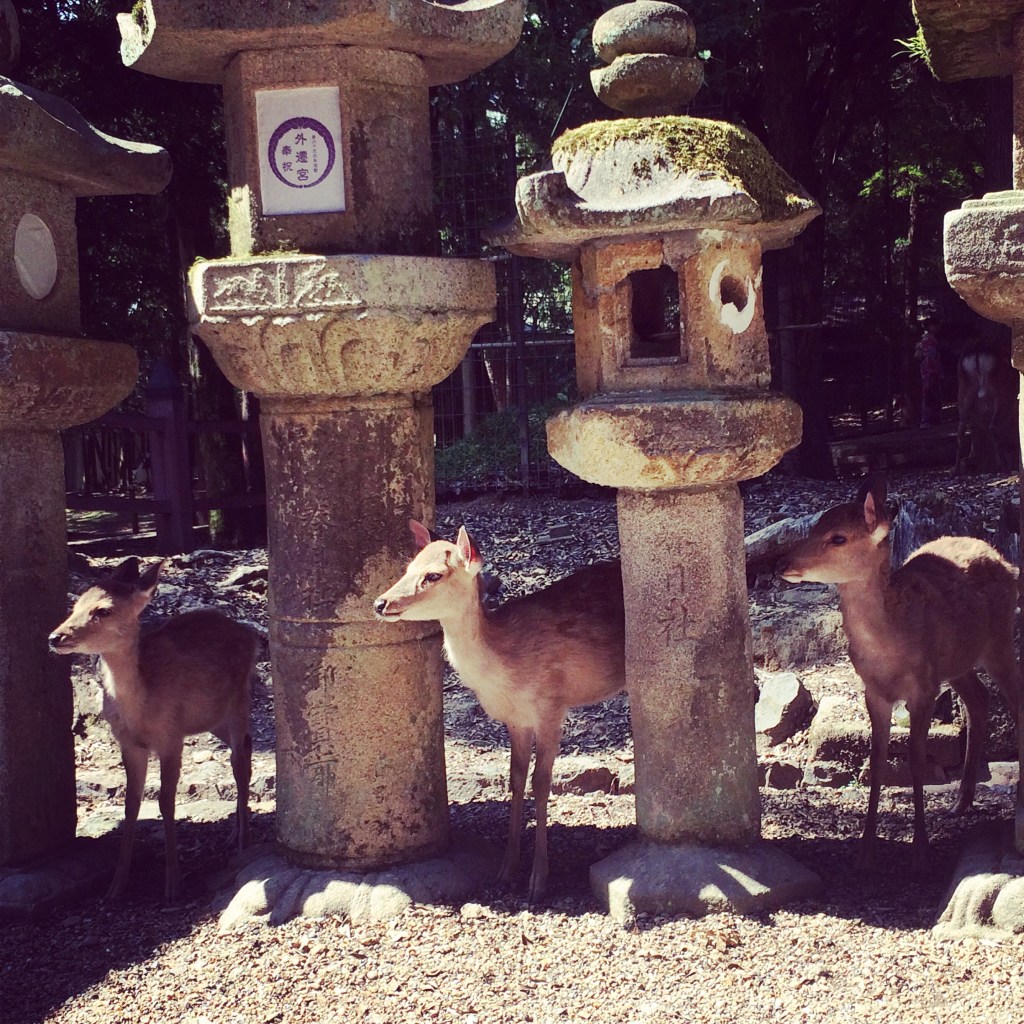
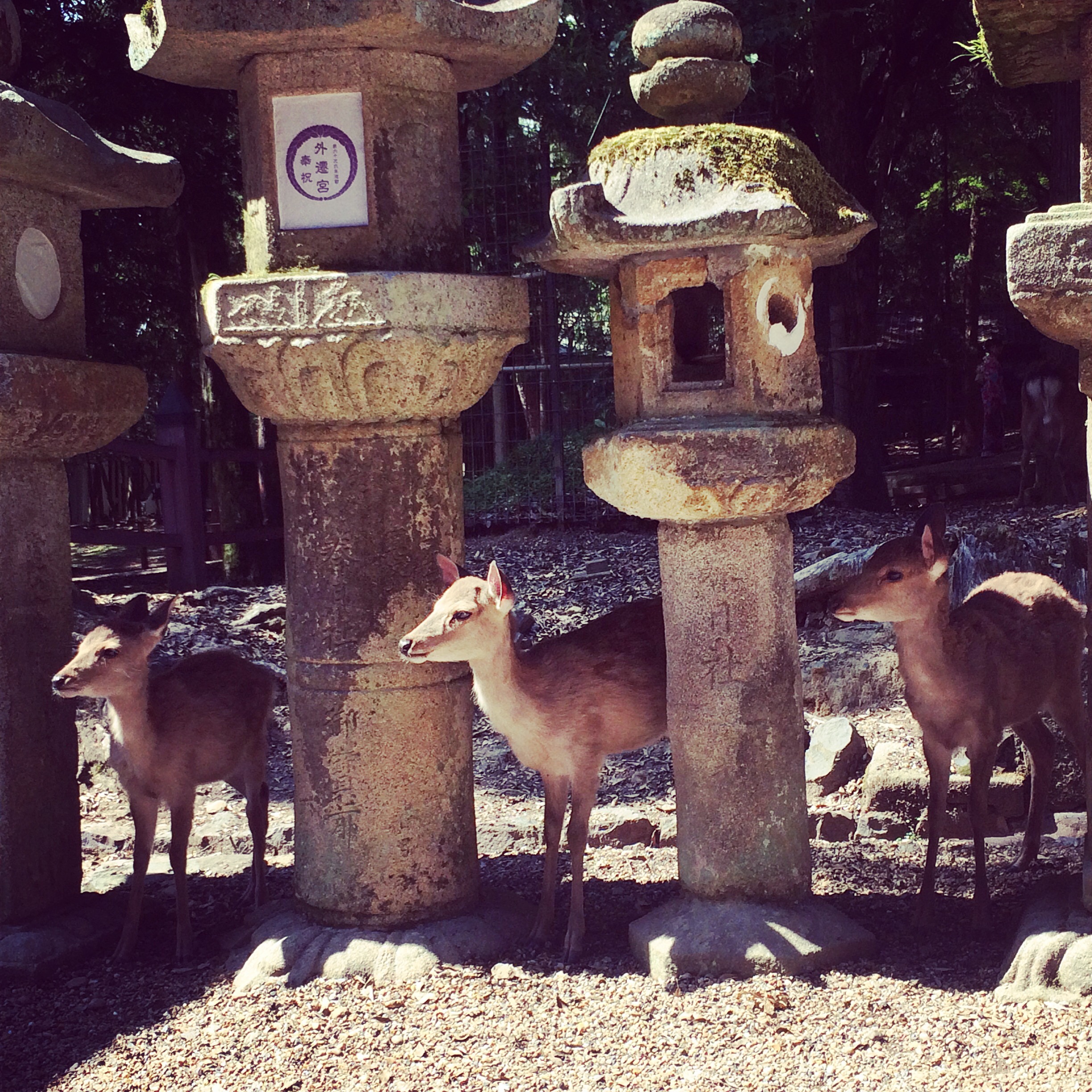
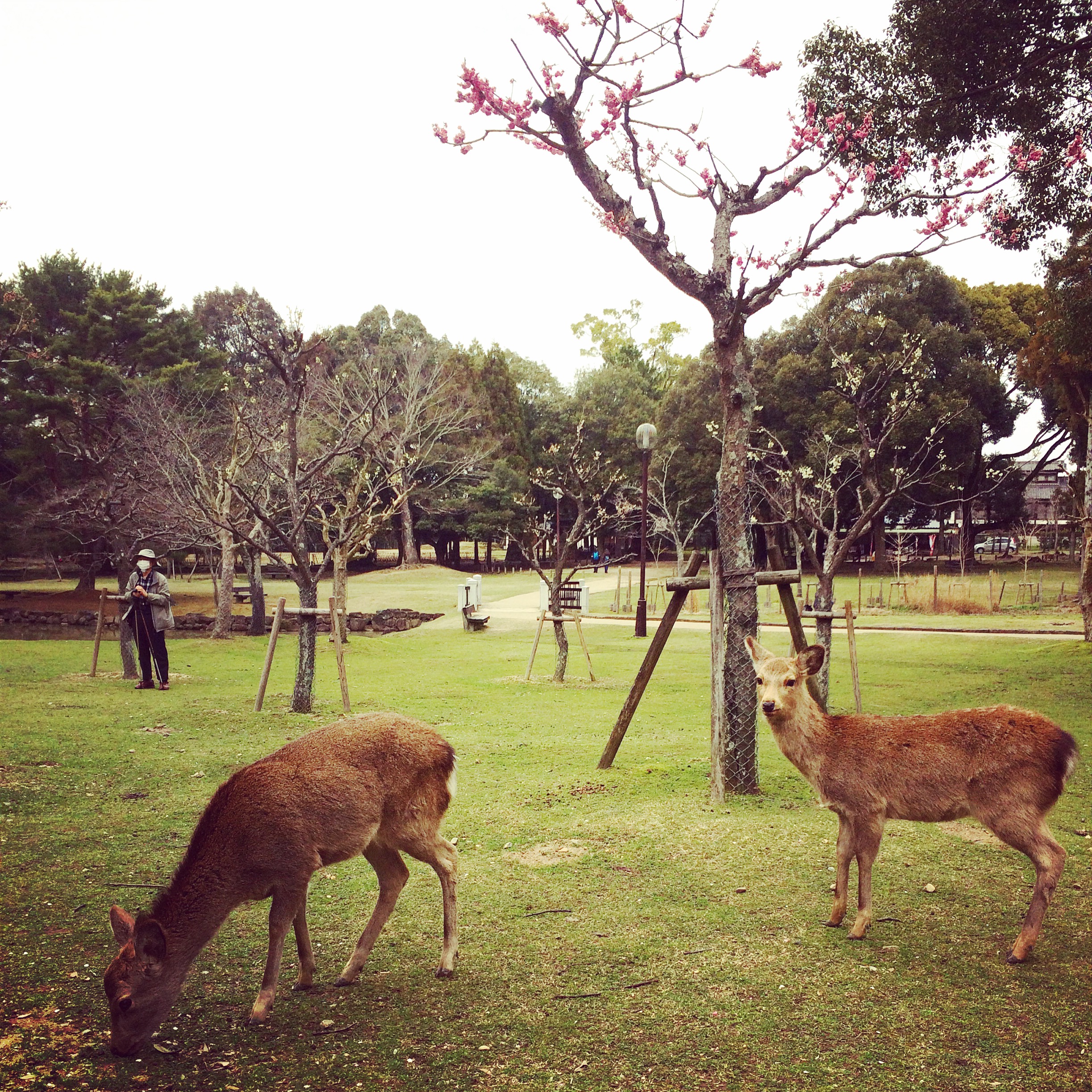
Nara. You’ve heard of it—at least, you’ve probably heard that there’s a spot in Japan just busting with wild deer, as ubiquitous and slightly unnerving as pigeons in New York.
No one knows for sure why these deer originally settled in Nara. Among its many shrines and temples, there is one for Takemi Kajichi no Mikoto, a mythological deity, said to have ridden into Nara on a deer. Because of this legend, deer have been deemed sacred in Nara for 1000 years, and hunting is forbidden around the national park, allowing the population to explode.
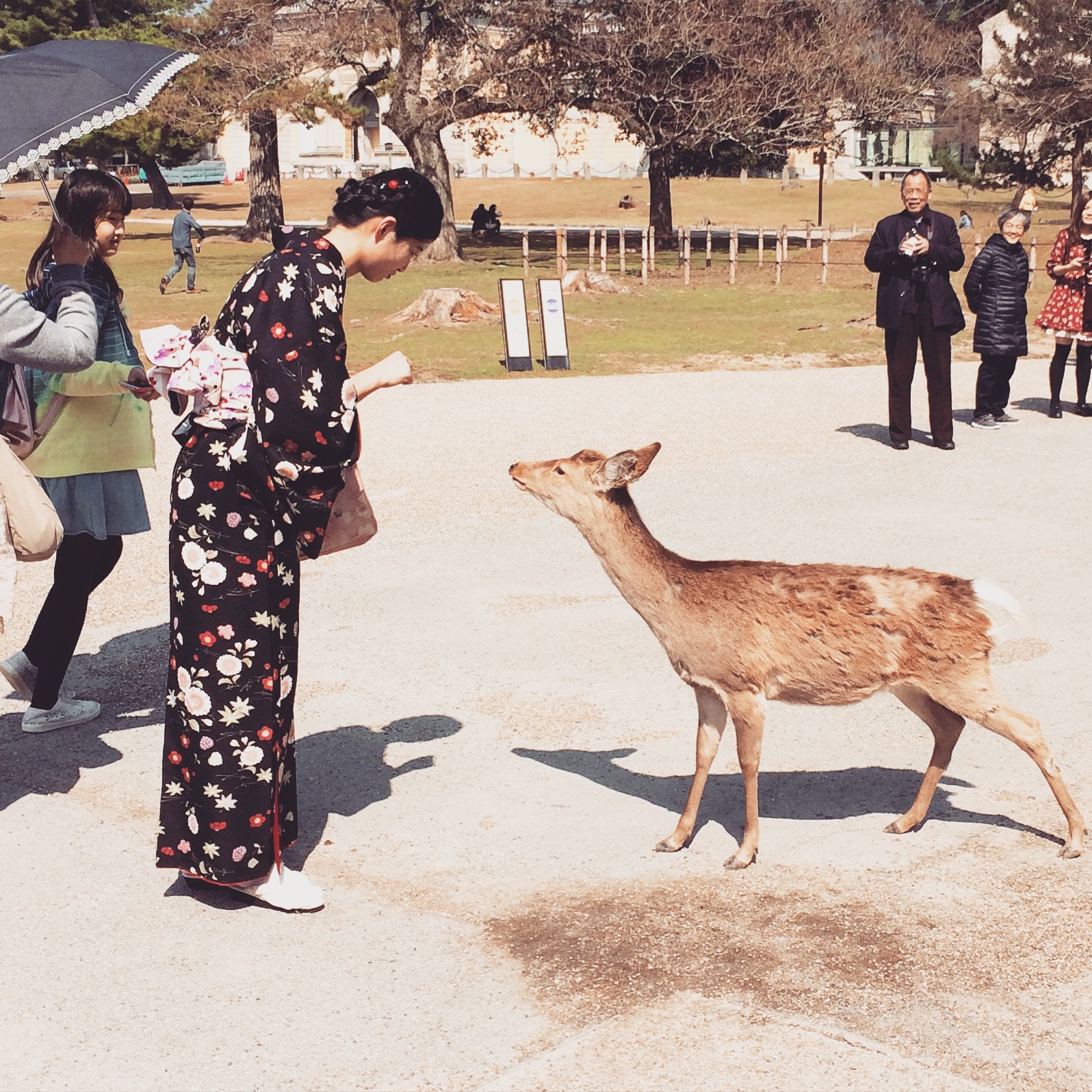
The wildlife can be quite a headache for locals, but it seems they wouldn’t change a thing. From overseas visitors to multigenerational residents, all seem to agree with my personal assessment:
Nara Park is breathtaking.
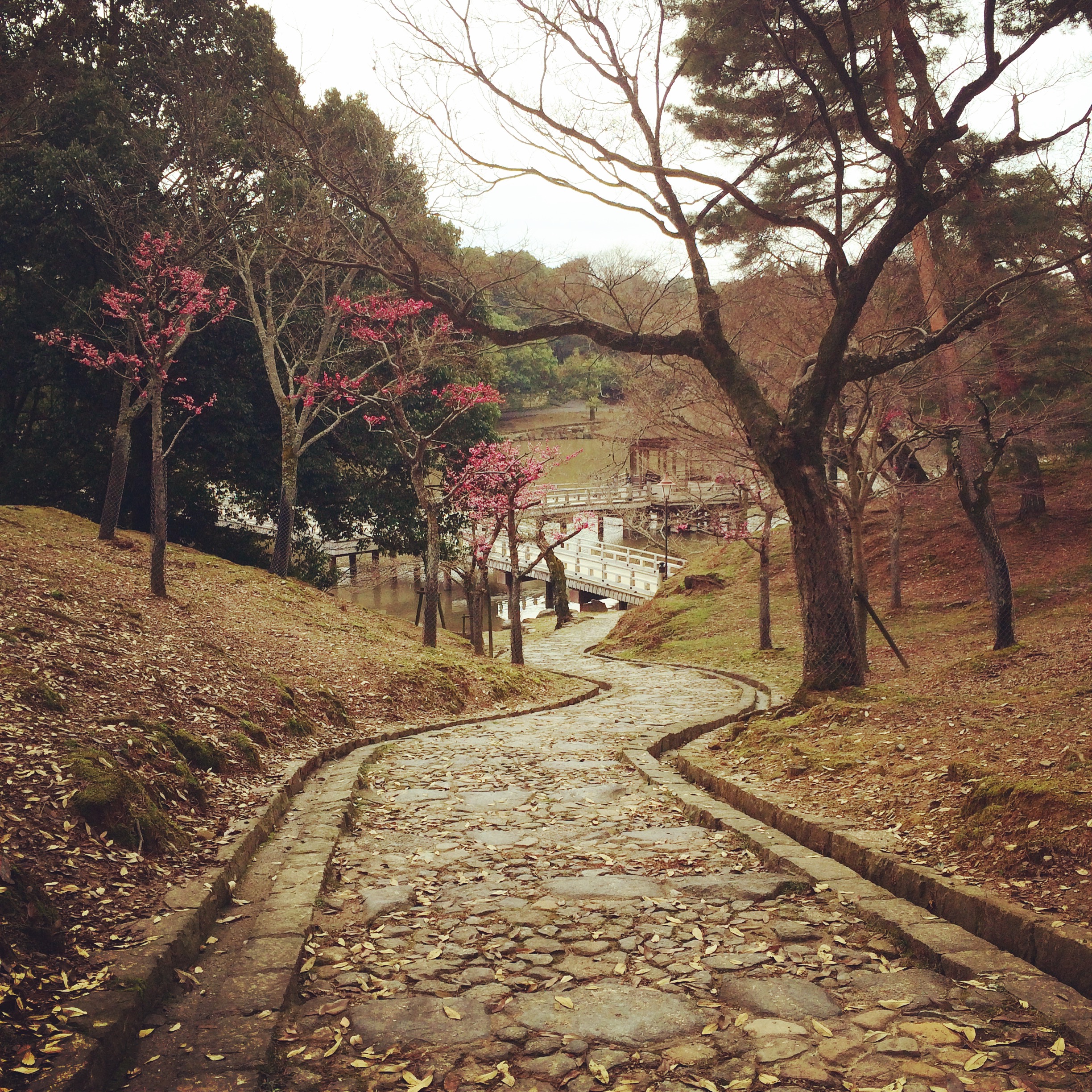
Today, the park is home to historical sites and museums, beautiful forests and meadows, ancient architecture, and about 10 million tourists buying crackers in order to exchange bows with the deer before feeding them, all for the thrill of running away shrieking the moment you run out of crackers and suddenly have Hell’s Angels in antlers ganging up on you while your friends laugh and film from a safe distance.
It’s a good-clean-fun way to spoil a beautiful walk and I love going there every time I need a break from the urban jungle of Osaka.
Such is my motivation on my very first trip in 2013. I brave an hour in the private rail lines to the countryside and go searching for a national park full of evil Bambies. Fiercely proud of my nervous, train-illiterate self, I somehow find park entrance, take a deep breath of fresh air full of animal dander, sakura pollen, and sunshine, and strike out for a lovely, quiet day of nature and happy humans.

I make it one deer-selfie into the park before things get weird.
First, I sat on a stump for my selfie and now my favorite shorts are covered in tree sap. Second, I hear a pleasant voice from above asking me where I’m from.
This is a common interaction for me; no intro, just this phrase taught in middle school English class, and the most pressing curiosity about any foreigner. It works great for me, I only know basic replies, plus a whole lot of useless fantasy anime vocabulary. If he wanted to know about my recently acquired Shining Blade of the 14 Heavens katana technique or to hear my speech on the abhorrent notion of forsaking our comrades in the face of deadly odds and crushing despair, I’d be all over it.
But this works, too.
“I’m from America.” Nailed it.
He’s an elderly gentleman in a white bucket hat, holding an expensive long-lens around his neck, and clearly geared up for a grueling hike rather than a leisurely stroll. He asks if I’ve been to Nara Park before. “No, it’s my first time.”
I’ve been winning crowds with this phrase on my trip. Japan is one of the most visited tourist destinations since 2023, but here in 2013, it’s rare to see an American, especially one who left the magnetic pull of Tokyo for the lesser known rural landscape of Nara.
I’m always down for a conversation attempts with anyone I meet, but today, I’m a little tired, overstimulated from Osaka, and eager to get into the park and be alone with my thoughts. Tanaka-san knows little English and I know even less Japanese, so this one shouldn’t take long.
But then, abruptly, my brain translates an offer. Not an offer exactly; he says he is now going to graciously take me on a tour of the entire park. I shall have a wonderful time and learn much, says he, come now, let us be off. Oh no. Oh shoot.
I’m being kidnapped.
It’s an utterly non-aggressive, well-meant crime, since the victim is making no attempt to resist or protest. Why? Because a nice Japanese gentlemen invited her to join a nice, free tour.
Queue the Second Language Courtesy Paralysis.
This is a phenomenon in which our subject, Katy, turns to cute, stammering driftwood when she is confronted by the need to complete a polite, diplomatic exchange and lacks the Japanese chops and boundary-setting wherewithal to do so. If she can’t refuse politely and in Japanese, she can’t refuse at all. That’s great, Katy, that’s a really efficient, sustainable way to solo-travel.
Katy is now on a guided tour of Nara Park with no idea how to escape.
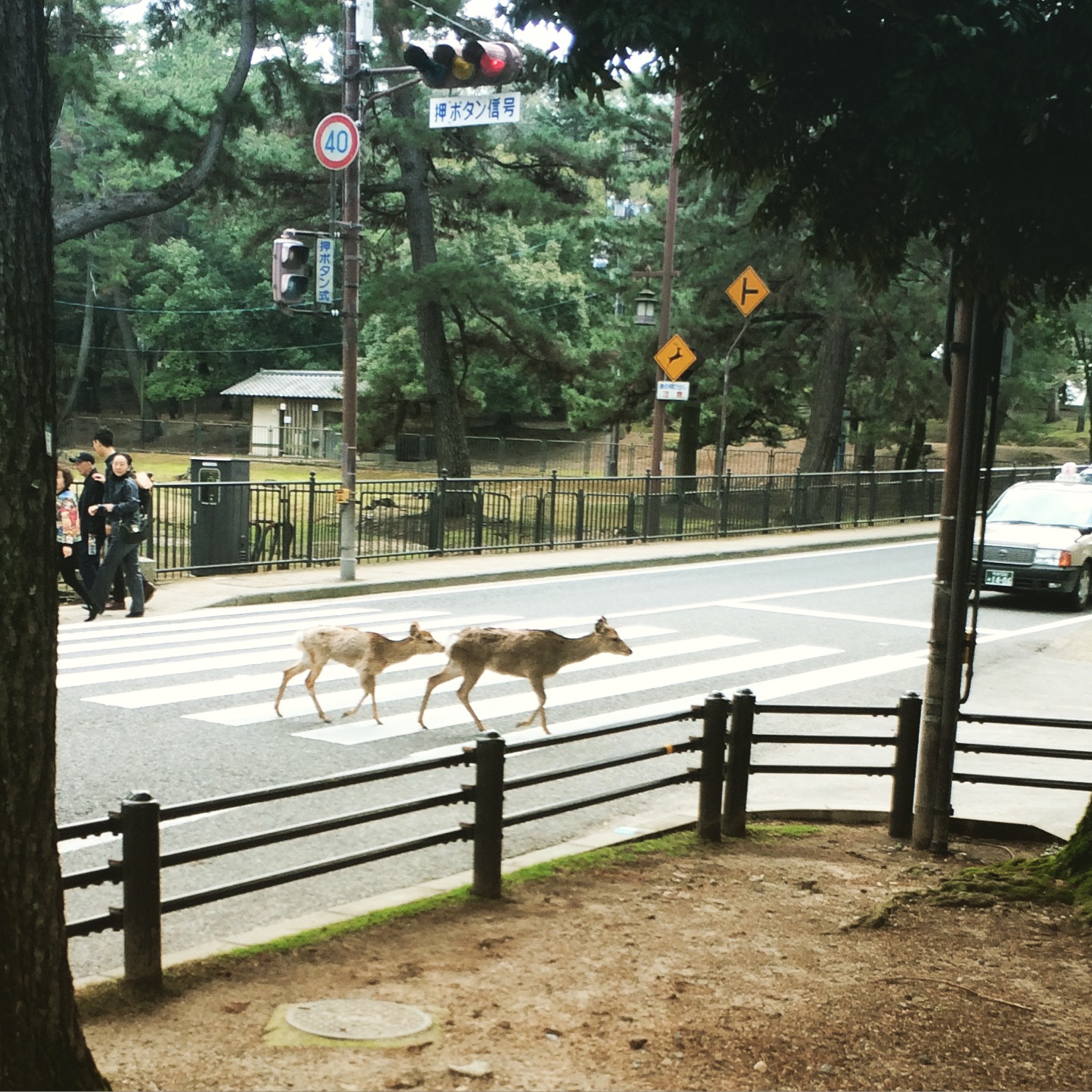
Tanaka-san leads us away from the park entrance to a municipal building across the road, which houses tiny city models and plaques I can’t read about the history of Nara. Tanaka-san explains everything, but I only understand enough to know that that’s what he’s doing.
I’m sad to be in this stuffy, carpeted building, away from the nature I came here for, and kicking myself for only learning “thank you”, not “no thank you.”
There is a special exhibit here today: an earthquake simulator.
Tanaka-san asks if I want to try it. No, I do not. “Thank you, yes.” All I got.
I strap in while the nice attendants in neckties tell me what to expect. I’ve never felt an earthquake, so even if I could understand, I doubt it would help me brace myself or feel less weird. I’ve decided to tell myself that I came here to experience everything I could about Japan, and the feeling of an earthquake, simulation or no, definitely seems like part of that. It’s working, actually.
I feel slightly less stupid about being kidnapped.
They start at 1 on the Richter Scale and the simulator mostly feels like a caffeinated massage chair for a few seconds. The two attendants merrily relay a history of these small quakes in various parts of the world. M2-4 roll by, and I barely bounce around, though I can see how damage could result from these.
But by 6, the simulator is more like a wooden roller coaster, tossing me around and jarring my inner ears. Before I know it, we’ve exited the Richter scale and moved into Moment Magnitude, a method of seismic measurement developed in the 1970s when the Richter Scale proved insufficient to gauge magnitudes of 8 and higher. The attendants are telling me of fewer historical earthquakes, because such sizes are rare.
I don’t know Japanese geography well enough to keep up with their descriptions and city names, but right before the final simulation, the attendant nearest says something to Tanaka-san which I instantly recognize.
“Sendai.”
I freeze. I want to get out. And maybe… some part of me doesn’t.
The Great East Japan Earthquake shook me, too, though there was little to be felt on the opposite side of the world that day. It’s just what first broke my heart for Japan, tore at me with an urgency to come here, because everything was broken, and people were in pain, and I wanted to be in it with them so I could share with them my source of hope and healing. But I wasn’t there. I couldn’t grasp their unspeakable loss.
I’ve never even felt an earthquake.
The simulator starts. It’s just a little shaky at first, rattling deep in the chair; a monster awaking underground. Then it bucks like an explosion, throwing me against the restraints, only to drag me down to the left and throw me right, seizing forward and back, thrashing and shivering, as if the earth is has given up holding together.
As if solid ground is nowhere to be had.
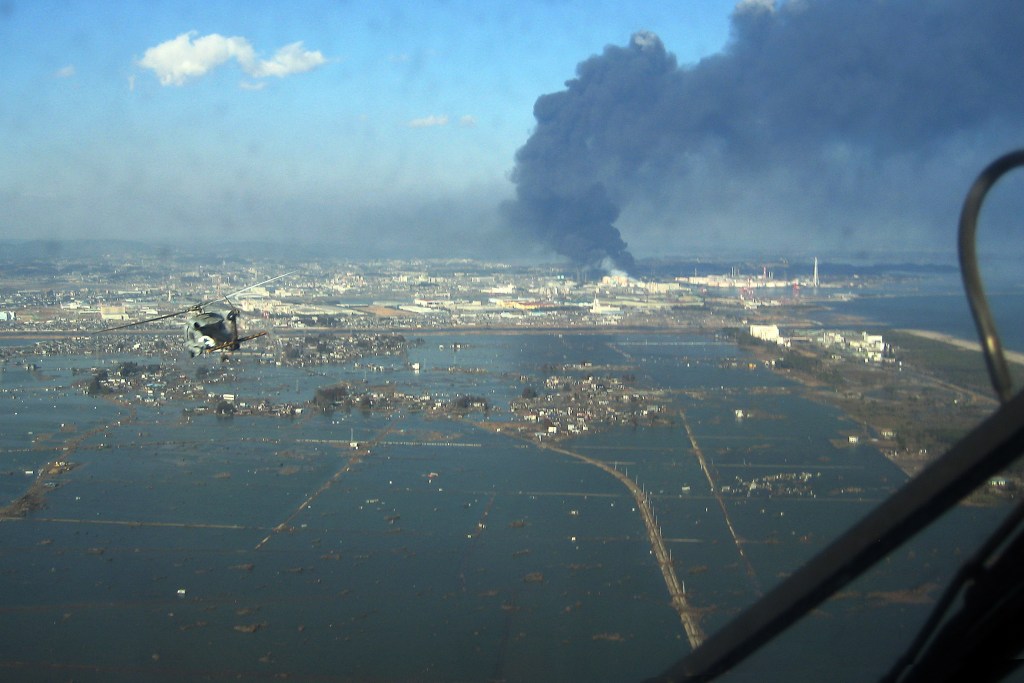
Most earthquakes last only a few seconds. The M9 on 3.11 lasted 6 minutes, rocking the whole of Japan, creating ocean swells throughout Asia, and triggering a 133′ tsunami off the eastern coast, which leveled most of the city of Sendai, flooded nuclear power plants, damaged or destroyed over a million homes, crippled Japan’s infrastructure, and resulted in nearly 20,000 deaths.
Repairs in Sendai continue to this day. But some things can never be restored.
By the time the simulator stops, I’m in tears.
Tanaka-san has been watching eagerly to see what I think, and the attendants are ready with their history lesson. But everyone falls silent when they see me crying, and I wonder wildly if I can explain myself.
“I remember,” I manage, fighting to pair broken Japanese with a broken voice and get it all out gracefully. “I remember that day. I was in America, but I was so sad. I was so, so sad and it hurts. I remember.”
It’s not graceful. It’s just my heart. I just want out of this chair and this tour now. But as I climb out of the simulator and follow Tanaka-san toward the exit, I glance over my shoulder, and I see the attendants exchange a quiet look. I realize belatedly that they’ve been doing it since the simulation stopped. The look is a little confused, a lot of surprised, and somewhere in between, it’s touched.
This day isn’t about to get any less weird for me. But that look lives rent-free in my memory, because I’m glad that a rare American came to Nara in 2013, 2 years after the 3.11 earthquake, and mourned the lost lives in front of three living Japanese souls. I remember feeling embarrassed about crying then, but I don’t now, because Jesus wept for souls, both lost and found.
He is the one who can heal and restore, he’s the conqueror of death and loss. But he still experiences our unspeakable pain with us. He knows what the people of Japan felt on 3.11.2011.
He was there.
I’m abruptly blinded by sunlight again and my distracted mind finally thinks to check my surroundings. I seem to be following Tanaka-san back across the road and into the park.
Still kidnapped.
To be continued…


 DO NOT CROSS
Leave a comment